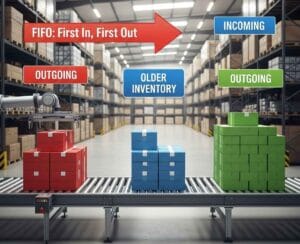
When managing inventory, one of the most important decisions is how to account for stock movement. Two common methods are FIFO (First In, First Out) and LIFO (Last In, First Out). Both approaches affect not only how goods move through the warehouse but also how businesses report costs, value inventory, and plan operations. Understanding FIFO vs LIFO in warehousing is key for efficient storage and accurate financial reporting.
What is FIFO in warehousing?
FIFO (First In, First Out) means the oldest stock is sold or used first.
- In warehouses, this means products that arrive earliest are picked and shipped before newer ones.
- Common in industries with perishable goods (food, medicine, cosmetics).
- Prevents spoilage, reduces waste, and ensures customers receive fresh stock.
What is LIFO in warehousing?
LIFO (Last In, First Out) means the newest stock is sold or used first.
- In practice, workers pick from the most recent deliveries first.
- Used in industries where products don’t expire quickly (e.g., construction materials).
- Can help match current sales with recent purchase costs in accounting.
FIFO vs LIFO in warehousing: key differences
| Factor | FIFO Method | LIFO Method |
| Stock Rotation | Oldest items sold first | Newest items sold first |
| Best for | Perishables, fast-moving consumer goods | Durable goods, industries with inflation concerns |
| Storage Layout | Requires careful shelf rotation | Easier picking from top/recent stock |
| Waste Control | Reduces risk of expired inventory | Higher risk of old stock building up |
| Accounting | Matches old costs with new revenue | Matches new costs with new revenue |
Advantages of FIFO
Minimizes product obsolescence – Because the oldest items leave the warehouse first, products are less likely to sit on shelves past their expiration or relevance date. This is especially important for perishable goods, fast-moving consumer products, or industries with short product lifecycles.
Customers receive fresher items – FIFO ensures that buyers get the newest quality possible. For food, cosmetics, or pharmaceuticals, this directly improves customer satisfaction and reduces complaints or returns.
Reflects real-world stock flow – In most businesses, goods are naturally sold in the order they arrive. FIFO mirrors this reality, making it easier to align warehouse operations with accounting and reporting practices.
Easier for warehouses with high turnover – In fast-moving warehouses, FIFO creates a smooth flow of products in and out. It reduces congestion, keeps inventory balanced, and simplifies shelf management for staff.
Simplifies compliance – Many industries with strict health and safety regulations (like food or healthcare) require FIFO to prove that stock rotation is being managed responsibly.
Advantages of LIFO
Can reduce taxable income in inflationary times – Under the Last In, First Out method, the most recently purchased (and usually more expensive) stock is recorded as sold first. This raises the cost of goods sold (COGS) during inflation, which can lower reported profits and, in some countries, reduce taxable income. It’s a strategy some businesses use to manage financial outcomes, though it’s not allowed everywhere.
Simplifies picking in bulk warehouses – In certain storage setups, especially where new stock is stacked on top of old stock, it is physically easier to remove the most recent items first. This can save time and effort for warehouse staff in large-scale or bulk storage environments.
Matches current costs with current revenue – LIFO ensures that the cost of the latest inventory (which reflects current market prices) is aligned with sales revenue. This gives a more accurate snapshot of profit margins in times of fluctuating prices.
Useful for non-perishable goods – Industries handling durable items (like raw materials, hardware, or construction supplies) may prefer LIFO since there is less risk of older stock expiring or losing value.
Can improve short-term cash flow – By lowering taxable income and delaying recognition of older, cheaper inventory costs, companies may retain more cash in the short term, which can be reinvested in operations.
Which method should your warehouse use?
The decision between FIFO vs LIFO in warehousing depends largely on the type of products you store, your industry, and your financial strategy.
- Choose FIFO if:
- Your stock has expiry dates (food, medicine, cosmetics, or any perishable goods).
- Customer satisfaction relies on freshness and quality, such as in retail or e-commerce.
- You want a method that mirrors real-world stock movement, reducing waste and simplifying compliance with health and safety regulations.
- Your warehouse has high turnover, where goods come in and out quickly and require smooth, continuous rotation.
- Choose LIFO if:
- You manage durable, non-perishable goods like raw materials, metals, or hardware that won’t spoil over time.
- You want to match recent costs with recent revenue for a more realistic view of profit margins during inflation.
- Your storage layout naturally lends itself to removing newer stock first, such as in bulk warehouses where items are stacked in layers.
- You operate in a country where LIFO is legally allowed for accounting and want to take advantage of potential tax benefits.
In practice, most businesses with perishables or high customer turnover choose FIFO. LIFO, on the other hand, tends to be used by industries less concerned with shelf life and more focused on cost accounting strategies.
Conclusion
When comparing FIFO vs LIFO in warehousing, it’s clear that the choice goes far beyond accounting entries. Each method shapes how products flow through the warehouse, how efficiently space is used, and how businesses control waste and costs.
FIFO works best for industries where freshness matters or where goods have limited shelf life. It helps reduce spoilage, improves customer satisfaction, and keeps stock movement natural and predictable.
LIFO, while less common globally, can be valuable for industries with durable goods and in regions where tax rules allow it. It helps align recent costs with sales revenue and may simplify picking in bulk storage environments.
Ultimately, the right approach depends on your products, your market, and your financial strategy. A warehouse handling perishable consumer goods will almost always benefit from FIFO, while a warehouse storing raw materials may find LIFO more practical.
FAQs
Can warehouses mix FIFO and LIFO?
Yes, some businesses apply FIFO for certain goods and LIFO for others depending on shelf life.
Which method is more cost-effective, FIFO or LIFO?
It depends. FIFO reduces waste and storage costs for expiring goods, while LIFO can lower taxable income during inflation in regions where it’s allowed.
How does FIFO vs LIFO impact financial statements?
FIFO matches older costs with current revenue, showing higher profits in inflationary times. LIFO matches recent costs with revenue, which may lower profits but give a more current cost picture.
Does FIFO vs LIFO change how warehouses are organized?
Yes. FIFO requires careful shelf rotation to ensure older stock is picked first, while LIFO can simplify layouts where new stock is more accessible.
Can FIFO and LIFO affect customer experience differently?
Yes. FIFO improves freshness and reliability for customers, while LIFO may leave older stock in storage longer, potentially lowering product quality if not managed well.
Which method provides a more accurate view of profitability?
FIFO works better in stable or low-inflation markets, while LIFO gives a more realistic view during inflation by aligning recent costs with current sales.